AI Breakfast #19
December 4, 2025
At our nineteenth AI Breakfast, our group of developers, entrepreneurs, data scientists, educators, and healthcare consultants discussed topics ranging from AI-assisted stock trading, browser automation agents, AI chat architecture decisions, to AI in drug appraisal and healthcare. The group also watched The Thinking Game documentary and debated the future of personal websites and how AI changes the way we consume information. Attendees shared their latest work, including Issue to PR, a voice-based website builder, an AI chat feature for education apps, and a drug appraisal platform using AI.
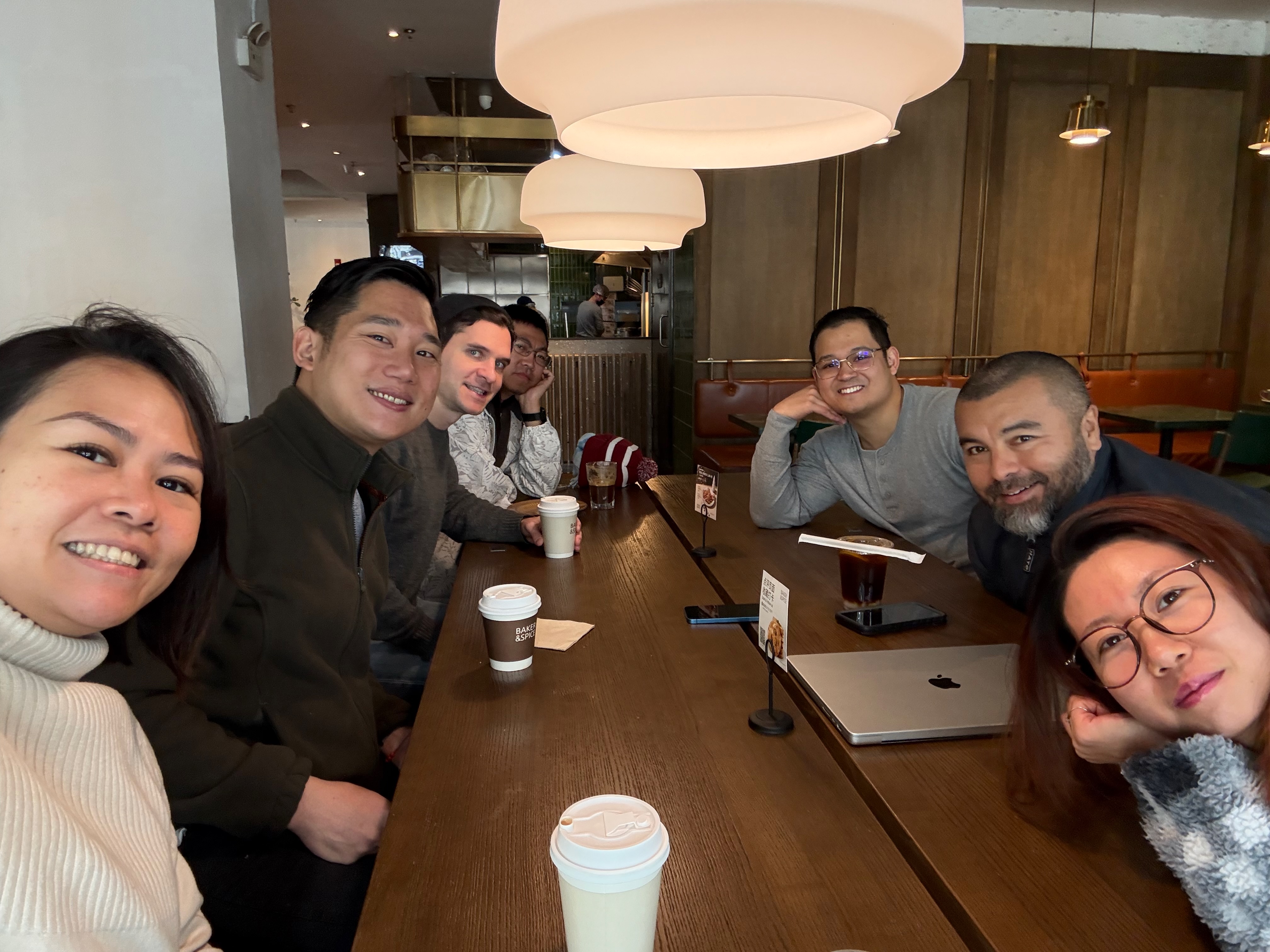

 Combination of our 2 photos with Gemini's Nano Banana pro. Hello double Aggy!
- AI Breakfast #19
- Member Introductions
- The Thinking Game Documentary
- AI-Assisted Stock Trading
- Browser Automation Agents
- The Future of Personal Websites and Social Media
- AI Chat Architecture for Education Apps
- AI in Drug Appraisal and Healthcare
- Vibe Coding and Production Readiness
- Background Agents and Testing
- AI and Information Consumption
- Economic Implications of AI
- Other Resources
Member Introductions
The host, who is building a voice-based website development tool, opened by sharing his struggle with writing tweets for marketing. He finds that AI-generated tweets come out sounding like marketing fluff, which he dislikes. Another attendee suggested using AI as a coach to improve writing skills rather than having it write for you directly.
A data scientist working in finance shared how he built a Python program to scrape market data and filter for specific technical patterns. He feeds screenshots of charts into ChatGPT to get feedback on investment opportunities. The process helped him move from idea to execution much faster than before.
A freelance AI tinkerer mentioned working on several projects related to marketing automation. Someone who founded a SaaS platform called Catalyst, which helps companies automate project management and email workflows, also attended. A full-stack developer shared that she has been working on an AI chat feature for an education app and dealing with connection issues related to the China firewall.
A consultant and entrepreneur working on 3D and spatial interfaces was also present. Near the end, a founder building an AI-powered drug appraisal platform joined and shared her story of transitioning from healthcare consulting to building her own startup.
The Thinking Game Documentary
Several attendees had recently watched The Thinking Game, a documentary about DeepMind and its founder - Demis Hassabis. The film follows his journey from before he joined Google through the AlphaGo matches and the AlphaFold breakthrough. One member called him a pure scientist who is quite responsible for Google's resurgence in AI.
The discussion touched on how AlphaGo's victory over the Korean Go champion in 2016 became a Sputnik moment for China. When the AI later beat the top Chinese player, the Chinese government reportedly cut the live feed mid-match when it became clear their champion was losing. This event pushed AI research to the top of China's priorities.
Members also noted that DeepMind went on to tackle StarCraft after Go. The documentary highlighted how giving away AlphaFold's protein structure predictions for free was a major scientific contribution. One attendee joked that parents should let their kids play games—one day they might win a Nobel Prize.
AI-Assisted Stock Trading
The data scientist explained his approach to technical trading with AI. He built a Python script that scrapes market data and filters for specific conditions—stocks or ETFs that show certain moving average patterns. The output is a shortlist of opportunities. He then takes screenshots of the charts and feeds them to ChatGPT, asking for analysis and feedback.
The key, he explained, is thinking about how institutions will react to market conditions. He compared his strategy to small fish following a shark: when a big player takes a bite, little pieces float everywhere, and he just wants to grab the nibbles. He said the hit rate matters more than any single trade—if you can win 53% of the time and lose 47%, you make money over time.
When asked if others could use the same approach, he said he could share ideas and trades. The real advantage of AI is speed—going from an idea to a working program quickly enough to act on current market conditions.
Browser Automation Agents
One member shared his experiment using browser automation tools to redeem Humble Bundle game keys. Humble Bundle is a subscription that provides eight to twelve games per month, but each key must be manually clicked, copied, and redeemed on Steam. He wanted to automate this tedious process.
He tried OpenAI's Operator and a tool called Comet, which runs browser sessions remotely. The sessions are stored in ChatGPT, but the allocation is limited—he could only process a few rows at a time before hitting timeouts. He found that externalizing progress into a markdown file or spreadsheet helped maintain context across sessions, similar to how he approaches coding with LLMs.
One challenge was Steam's bot protection. If you try to redeem a game you already own, Steam immediately flags you as a bot. He had to add logic to check his existing library before attempting redemption. The project started as a toy to test browser automation tools, but it revealed how fragile these systems still are for multi-step workflows.
The Future of Personal Websites and Social Media
A debate emerged about whether personal websites still make sense. One attendee asked why anyone would maintain a personal blog when platforms like Substack or Twitter already have audiences. Another pushed back, saying that being on platforms means giving away your relationship with readers to a third party. Facebook once had organic reach, but then started filtering algorithmic feeds so that only a fraction of followers would see posts. That shift drove people to Medium and Substack.
The group discussed how Threads is gaining traction as an alternative to Twitter. One developer said Threads feels less toxic and has no ads yet. She uses topic tags for visibility and finds it easier to build an audience there. Another noted that the tech community still lives on Twitter, making it hard to leave entirely.
Several attendees reflected on how the web has changed. One member pulled up his old forum from 2001, which he described as basically Facebook before Facebook existed—friends posting photos and life updates on a private site. The idea of making that public would have seemed wild at the time. Another remembered the early days of the browser when two columns that stayed in place on different screen sizes felt like a technical achievement.
AI Chat Architecture for Education Apps
Two developers working on an education app presented a diagram they made to visualize different approaches to AI chat. The question was whether to use a stateful API, where the provider stores chat history and you just send a session ID, or a stateless API, where you send the full context on every request.
The stateful approach, offered by OpenAI's Responses API, is simpler—you post a message, get a reply, and the session ID tracks everything. But it locks you into one provider and makes it hard to do your own summarization or context management.
The stateless approach means your backend stores the chat history and sends the full context each time. This gives you control over compression, summarization, and model switching. The downside is that context grows quickly, and you pay for tokens on every request. Cached tokens can reduce costs, but only if you keep the history intact and append new messages at the bottom.
One member recalled building similar systems three years ago when context windows were only 4,000 tokens. He would summarize at around 3,000 tokens, leaving room for the summary itself, then start fresh with that compressed history. Nowadays, 100,000-token windows make summarization less urgent, but context management remains important for long-running conversations.
The developers decided to go with the stateless approach so they can experiment with different models without being locked into one provider.
AI in Drug Appraisal and Healthcare
A founder who joined midway through the breakfast introduced herself as a drug appraiser. She spent over ten years in healthcare consulting, helping governments and payers assess the value of new pharmaceuticals. This work involves clinical research, data analysis, and economic modeling—a cross-disciplinary challenge that makes it hard to find qualified consultants.
She saw an opportunity to use AI for extracting structured data from research papers. Clinical trials publish results in journals, but the information is scattered across text, tables, and figures. Her prototype reads papers multiple times in truncated chunks, answers structured questions, and condenses the results. The process is not purely AI—Python scripts handle much of the logic because she wanted control over accuracy.
Existing AI tools for medical literature review often give you answers without showing the process, she explained. You get a table but cannot verify if it is trustworthy. Her approach gives researchers more control by making the extraction steps visible.
The discussion touched on where AI fits in the drug lifecycle. Early-stage investors need second opinions on pipeline assets, but traditional consulting is expensive and slow. Her AI tool could provide faster preliminary assessments, though clinical trials and regulatory approval still require human expertise.
Vibe Coding and Production Readiness
The drug appraisal founder asked how companies go from a proof of concept built with AI to production-ready code. The host shared a story about someone in Australia who built a complex app for the trades industry using Replit. The app worked—scheduling, invoicing, client management—but when he asked a development agency to make it production-ready, they quoted 125,000 Australian dollars because of all the spaghetti code.
One member argued that even with the cleanup cost, starting with a working prototype is better than starting from scratch. A traditional agency would charge more and deliver something less tailored to the domain. The prototype already has the functions and flows that the domain expert wanted. Getting a non-technical person to that point would normally require expensive discovery and back-and-forth with developers.
Another attendee suggested just shipping the prototype and letting real users break it. Production readiness might matter less than getting feedback. If people are signing up and paying, then you invest in hardening the code.
Background Agents and Testing
The conversation turned to background agents that run without supervision. One member mentioned Cursor's web agent, which lets you dispatch tasks from your phone. The idea is to have pull requests ready by the time you reach your desk.
The challenge is testing. Unit tests are straightforward—agents can run them in a terminal loop. Integration tests are harder. If your app requires OAuth or a live browser, the agent cannot easily spin up a testing environment. One member said the key is structuring your project so that npm run test handles everything, including environment variables and mocked services. Once that harness exists, agents can stay in the loop, but setting it up is the hard part.
Someone asked about running agents on mobile. Cursor has a web version that can be installed as a PWA, but it requires pay-as-you-go billing and environment setup. No one in the group had fully configured it yet.
AI and Information Consumption
A data scientist described his new habit of using AI to read The Economist. He downloads all the articles each week, compiles them into a PDF, and asks ChatGPT to summarize the top themes and talking points. He no longer reads the articles deeply—just the summary.
He acknowledged the trade-off: this saves time but means he is not building or maintaining the skill of deep reading. The summary gives him enough context for conversations but none of the nuance.
An educator raised concerns about how younger people read. Studies show that instead of tracking line by line, many now scan paragraphs in a scattered pattern, grabbing the gist and moving on. This works for some content but leads to shallow understanding when applied everywhere.
The group discussed whether AI accelerates this trend. One member noted that podcasts already function as background noise for many listeners—useful for ambient awareness but not for deep thinking. The Economist podcast, for example, covers the same material but does not replace sitting down with the text.
Economic Implications of AI
Near the end of the breakfast, the conversation drifted into broader questions about AI and society. One member argued that AI is inflationary in a counterintuitive way: it lets you produce the same output for less, which drives prices down but also reduces employment. If fewer people have jobs, fewer people can buy products, even if those products are cheaper.
He worried that entry-level jobs are most at risk. AI can handle the tasks that used to train junior employees. Without those stepping stones, how do people build expertise?
Another attendee pushed back, saying that people with domain expertise and trained attention spans have an edge. Those who grew up reading books and solving problems without AI developed cognitive skills that AI now amplifies. The concern is for younger generations who might skip that training entirely.
The discussion touched on housing, marriage, and cultural pressure. One member noted that in America, there is less pressure to get married by a certain age, while in China, the expectations remain strong. Economic stress compounds these pressures—if housing is unaffordable and jobs are insecure, people delay major life decisions.
No conclusions were reached, but the conversation reflected a shared unease about how fast things are changing and whether institutions can adapt quickly enough.
Other Resources
- ChatGPT – OpenAI's conversational AI. Used by one member to analyze stock charts and get investment feedback, and by another to summarize weekly Economist articles into digestible talking points.
- OpenAI Operator – Browser automation tool from OpenAI. One member experimented with it for automating Humble Bundle game redemption but found allocation limits restrictive.
- Perplexity Comet – Browser automation tool that runs sessions remotely. Used alongside Operator for the Humble Bundle automation project.
- The Thinking Game – Documentary about DeepMind and its founder Demis Hassabis. Several attendees had recently watched it and discussed its portrayal of AlphaGo and AlphaFold.
- DeepMind – Google's AI research lab. The Thinking Game documentary about its founder and AlphaGo sparked discussion about AI's Sputnik moment for China.
- Humble Bundle – Monthly game subscription service. One member built an automation project to redeem keys more efficiently.
- Steam – Gaming platform where Humble Bundle keys are redeemed. Bot protection makes automation tricky.
- Threads – Meta's Twitter alternative. One developer praised it for being less toxic and having no ads yet, making it easier to grow an audience.
- Substack – Newsletter platform. Discussed in the context of owning your audience versus depending on platform algorithms.
- Medium – Blogging platform. Mentioned as part of the shift away from Facebook when organic reach declined.
- Replit – Cloud-based coding environment with AI agents. One member referenced a non-developer who built a complete trades industry app using it.
- Cursor Background Agents – AI-powered code editor's web agent feature. Discussed for its background agent capabilities and PWA version that can run on mobile.
- OpenAI Responses API – Stateful chat API that tracks session history. Discussed as one approach to AI chat architecture, though it locks you into OpenAI.
- IQVIA – Global medical information and consulting company. Mentioned as the dominant player in healthcare data and consulting that makes it hard for small startups to compete.
- Dassault Systèmes Living Heart – Engineering software company's digital heart simulation project. One member mentioned their simulated heart being used for drug trials accepted by the FDA.
- Fotor – Online design tool with integrated AI image generation. One member recommended it for generating high-resolution images and QR codes that actually work.
- Manus – AI agent platform. One member used it to generate diagrams from economics papers but found it expensive when left running.